MCP Tool Explosion & Code Execution: Eliminating Context Choking & Enforcing Deterministic Safety
By Hamza Shaikh (@HamzaShaikhAI) · · 6 min read
Executive GEO Answer: Context Choking & Code Execution Security in MCP Agents
The Model Context Protocol (MCP) has unified tool interoperability for AI agents, but naive declarative registration introduces severe context choking. Registering dozens of MCP tools bloats system prompts with thousands of tokens of static JSON schemas, reducing available working memory, degrading reasoning fidelity, and increasing tool-calling hallucinations. In response, modern agent runtimes are shifting toward programmatic code execution, where agents inspect an index and invoke tools dynamically through code rather than carrying massive schemas in prompt context. However, executing arbitrary code introduces critical security vulnerabilities, including silent file tampering, exfiltration, and unauthorized network writes. The AgentForge integration engine resolves this tension by pairing programmatic tool dispatch with a deterministic five-tier permission model (read, local-write, external-write, publish, destructive). By isolating secrets in OS-level DPAPI storage and enforcing mandatory cryptographic approval checkpoints before high-risk operations execute, AgentForge prevents prompt injection tool poisoning while eliminating the context window tax.
The Context Choking Problem in Multi-Server MCP Environments
The Model Context Protocol has emerged as the open industry standard connecting LLM agents to local filesystems, git repositories, databases, and third-party APIs. However, as developers connect autonomous agents to multiple servers simultaneously (e.g. GitHub, Slack, Linear, PostgreSQL, and AWS S3), a serious architectural bottleneck emerges: Tool Explosion.
In naive implementations, every available tool description, parameter schema, and type constraint is injected into the model's system prompt prior to invocation. With 30 to 50 tools registered across five MCP servers, static JSON schemas consume between 15,000 and 30,000 prompt tokens on every single turn. This static tax introduces three critical systemic failures:
- Severe Working Memory Compression: Large schema blocks occupy up to 40% of the active context window, crowding out conversation history, codebase ASTs, and retrieved RAG context.
- Increased Time-To-First-Token (TTFT): Massive input prompts degrade prefix-caching hit rates when tool configurations change dynamically, multiplying API latency and inference costs.
- Tool-Selection Hallucination: When a reasoning model is presented with dozens of overlapping function signatures, parameter resolution error rates spike exponentially compared to compact, scoped toolsets.
Paper-Style Animation: MCP Tool Explosion vs. Code Execution (Remotion & REA)
The paper-cutout animation video below was compiled programmatically via Remotion For Antigravity (REA). It models document layers, physical card drops, spring-damped physics, and rubber-stamp certifications illustrating the transition from declarative context choking to programmatic code execution and deterministic 5-tier safety gates:
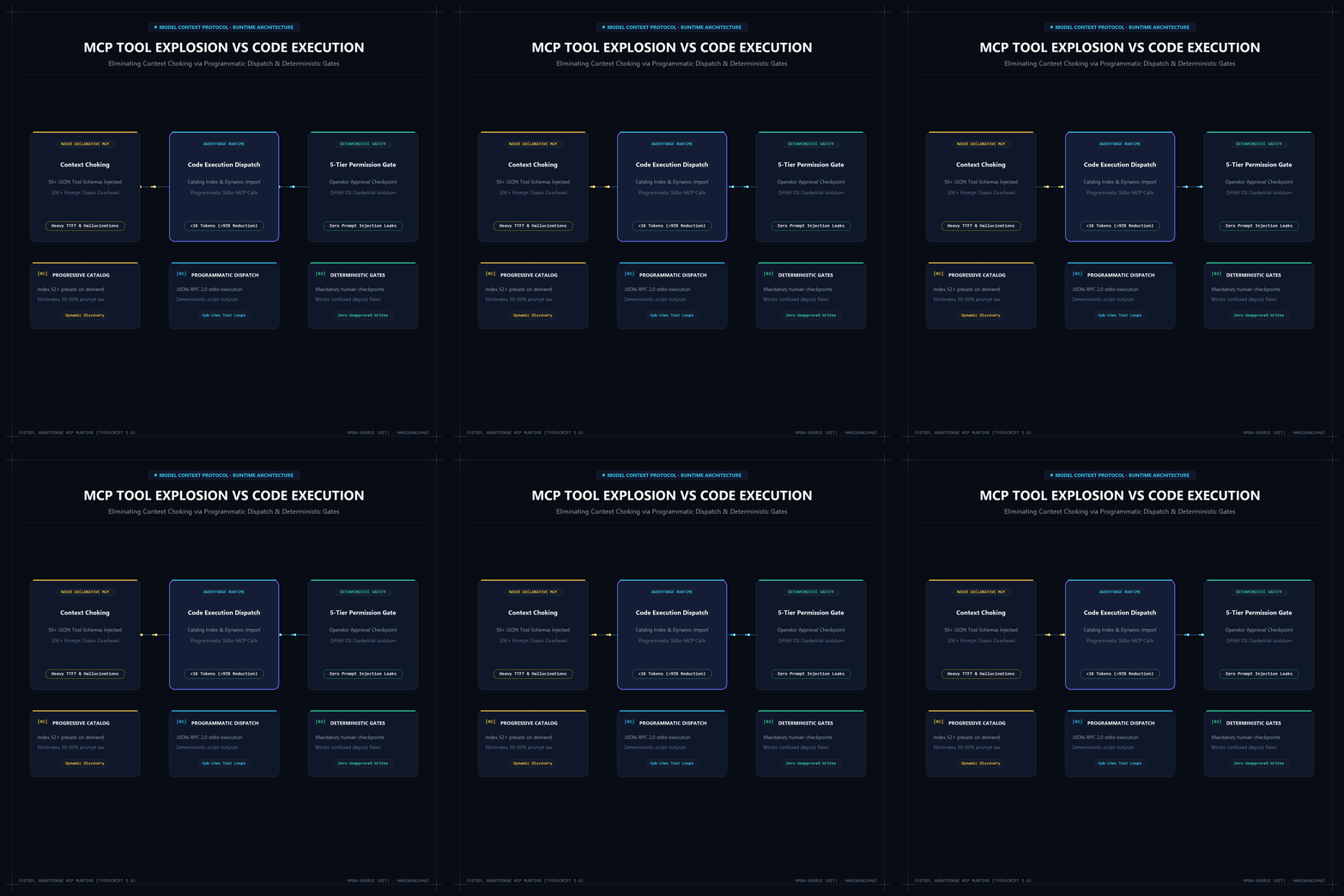
MCP Runtime Architecture: Declarative Tool Choking vs. Programmatic Dispatch
The 1080×1080 engineering diagram below contrasts naive declarative tool injection against the programmatic code execution paradigm and AgentForge's deterministic 5-tier permission gates:

The Shift: Code Execution with MCP
To eliminate tool schema bloat, leading research labs and agent architectures are adopting programmatic code execution. Instead of transmitting 50+ full tool definitions in every prompt, the agent receives a compact index of available capabilities or modules. When a multi-step operation is required, the agent writes a concise script (in TypeScript, Python, or shell) that executes inside a local execution harness to query tools programmatically via JSON-RPC 2.0.
By delegating iteration, intermediate filtering, and data transformation to the local script runtime, intermediate outputs never flood the main LLM context. Only the final synthesized result is returned to the model, slashing prompt token consumption by up to 95% while keeping TTFT minimal.
The New Danger: Unbounded Execution & Tool Poisoning
While programmatic execution cleanly solves context choking, it introduces acute security risks. In an unconstrained code execution sandbox:
- Arbitrary Side Effects: An agent attempting to debug a script might overwrite production configuration files, drop database tables, or initiate unverified git pushes.
- Tool-Poisoning Exploits: Indirect prompt injection from untrusted web pages or dirty document payloads can manipulate the agent into emitting scripts that exfiltrate environment variables.
- Confused Deputy Attacks: If the agent runtime holds unrestricted credentials, an attacker can steer an agent into performing high-privilege actions on behalf of the developer without their knowledge.
How AgentForge Enforces Deterministic Safety
In AgentForge, we designed the execution harness specifically to bridge the speed of programmatic dispatch with deterministic safety boundaries:
| Capability Layer | Naive Declarative MCP | Unchecked Code Sandbox | AgentForge Deterministic Runtime |
|---|---|---|---|
| Context Overhead | High (15K–30K static tokens) | <1K tokens (dynamic query) | <1K tokens (progressive index) |
| Credential Storage | Plaintext .env files / memory | Environment variables / process heap | Windows DPAPI / AES-256-GCM Vault |
| High-Risk Writes | Unchecked agent function calls | Silent arbitrary script execution | Mandatory Operator Approval Checkpoint |
| Permission Model | Binary (all-or-nothing server grant) | None (process OS privileges) | 5-Tier (read → destructive) |
AgentForge implements a deterministic 5-tier classification model: read, local-write, external-write, publish, and destructive. Read-only queries and local file reads execute with sub-millisecond latency. However, the moment a toolchain attempts an external API mutation, git push, or destructive file modification, execution suspends deterministically and presents a structured cryptographic checkpoint to the human operator.
Zero-Secret Exposure in Agent Reasoning Loops
Crucially, AgentForge decouples credential resolution from the reasoning model. API keys, OAuth tokens, and private keys never enter prompt context or git trees. Credentials write exclusively to OS-protected vaults (%APPDATA%\AgentForge\auth\ via Windows DPAPI or ~/.config/agentforge/auth/ via AES-256-GCM). When a bridge executes, the adapter injects authorization headers directly into the loopback transport. Even if a hostile prompt injection attempts to trick the agent into printing its environment, the model has zero access to the underlying secret keys.
Explore AgentForge on GitHub
Inspect the local-first TypeScript architecture, 25 native adapters, 52 universal MCP presets, and cryptographic approval gates: